By Wouter Evereart, Senior Project Director, Invesis
The award of the second lot of the Scholen van Vlaanderen programme to the consortium Scholen op Maat (SOM), a partnership between Invesis and Belfius, marks more than the procurement of another series of school buildings. It signals the continued evolution of public-private partnerships (PPP/PPS) in Flanders, a model that, in my view, has evolved from experimentation into one of the most effective delivery mechanisms for large-scale public infrastructure.
To understand the significance of this programme, it is necessary to place it within the broader history of PPPs in Belgium and Flanders, and particularly within the long journey of educational infrastructure delivery through AGION, the Flemish Agency for Educational Infrastructure.
From PPP Experiment to Delivery Platform
Over the past two decades, Flanders has developed one of the most mature public-private partnership (PPP/PPS) markets in continental Europe. What started as an alternative financing mechanism has evolved into a sophisticated project delivery model capable of delivering transport, social, educational and sports infrastructure at scale. Having worked with PPP structures for many years, I believe this transformation is one of the defining developments in the Flemish infrastructure market.
A significant catalyst for this evolution was the establishment of Via-Invest, through which Flanders successfully delivered major mobility projects using design, build, finance and maintain (DBFM) structures. Around the same period, PPP delivery expanded into the rail sector through projects such as the Diabolo rail link and the Invesis backed Liefkenshoek Rail Tunnel (Locorail), demonstrating that private financing and long-term maintenance obligations could also support complex transport infrastructure. These projects helped establish the contractual, financial and institutional expertise that would underpin future PPP programmes across Flanders.
The PPP model subsequently expanded beyond transport into social infrastructure. Sports facilities, prisons (such as the Beveren and Dendermonde prison supported by Invesis) and later educational infrastructure increasingly adopted integrated lifecycle approaches that combined design, construction, financing and maintenance responsibilities within a single long-term framework. Over time, public authorities, lenders, investors and contractors developed a shared understanding of risk allocation, performance management and lifecycle asset stewardship, creating one of the most mature PPP ecosystems in Europe.
In my experience, these successive programmes transformed PPPs in Flanders from an experimental procurement model into a proven delivery platform. By the time AGION launched successive waves of school infrastructure programmes, the market had accumulated nearly two decades of practical experience. For me, the key lesson was clear: aligning design, construction and maintenance incentives over the long term encourage a genuine whole-life asset management approach rather than a purely capital expenditure mindset.
AGION's PPP Journey
In my view, no public authority in Belgium has accumulated more practical DBFM experience than AGION.
By the early 2000s, Flanders faced a growing backlog in school infrastructure investment. Traditional subsidy mechanisms were unable to reduce waiting lists quickly enough. The response was the pioneering Scholen van Morgen programme, formally launched in 2010 following a procurement process that started several years earlier.
The scale was unprecedented. Scholen van Morgen ultimately delivered 182 school projects, representing approximately 707,000 m² of educational infrastructure and serving more than 125,000 students across all education networks in Flanders. The programme combined design, build, finance and 30-year maintenance obligations under a single structure.
Importantly, AGION's subsequent evaluation found broad satisfaction among participating schools and confirmed several of the model's strengths, including certainty regarding budget, maintenance quality and long-term asset performance.
Like any pioneering programme, it also generated valuable lessons. School boards sometimes experienced long development timelines, and the closed nature of the initial portfolio together with a strict contractual framework limited flexibility. Those findings shaped the next generation of school PPPs.
The second step came through the project-specific DBFM programme, often referred to as "Wave 2". Rather than procuring a single mega-portfolio, AGION moved towards smaller clusters and individual projects. This enabled greater flexibility, allowed school boards to enter programmes at different moments and attracted a broader range of market participants. The project-specific DBFM procurements also created opportunities for specialist investors such as Invesis, which successfully participated in several clusters, including the Egied van Broeckhoven School in Molenbeek-Saint-Jean and the Evara Schools cluster including three campuses in Turnhout, Ghent and Zelzate.
Today, Scholen van Vlaanderen represents the third generation of Flemish educational PPPs.
Scholen van Vlaanderen: A Third Wave
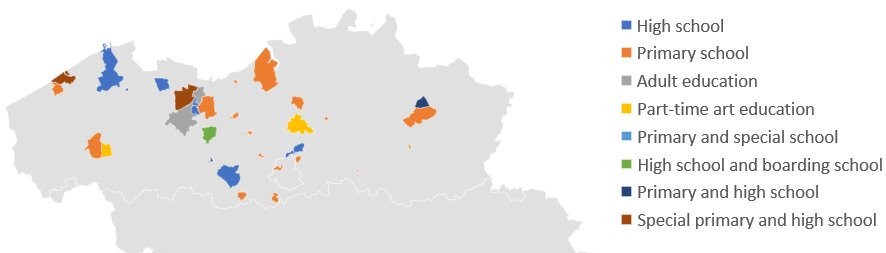
The Flemish Government has positioned Scholen van Vlaanderen as a new investment wave worth more than €1 billion, divided into three lots of similar scale. The programme is expected to deliver approximately 500,000 m² of new or thoroughly renovated school infrastructure across around ninety projects.
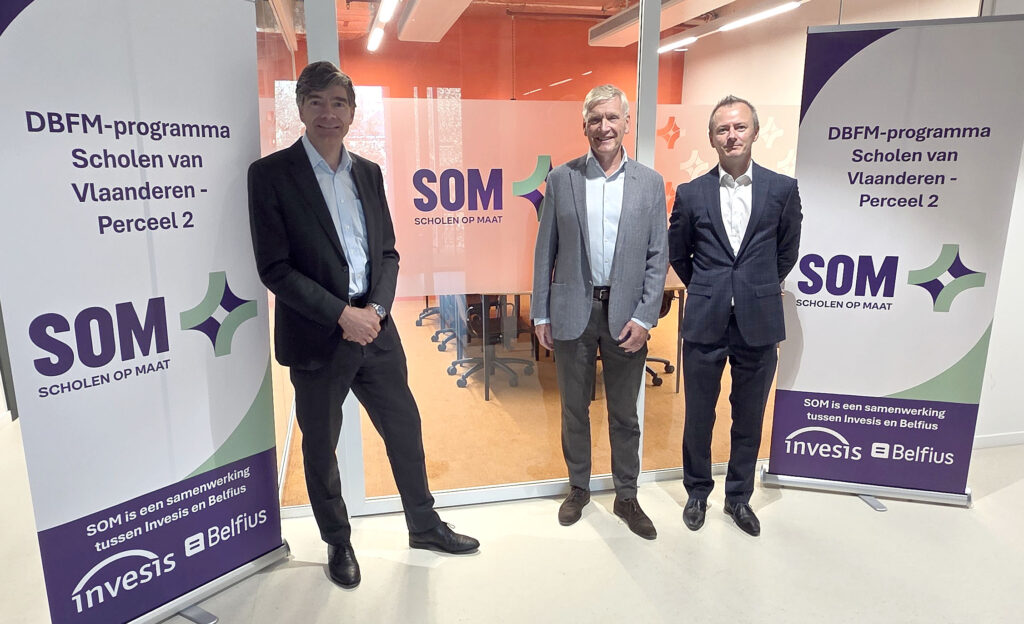
Lot 2 was awarded in 2026 to Scholen op Maat (SOM), the consortium formed by Invesis and Belfius. Under the agreement, SOM will develop, finance, build and maintain 37 schools with a total surface of approximately 176,000 m² for a period of 30 years. The programme represents an investment of roughly €500 million, creating capacity for more than 20,000 students.
For me, the real innovation lies not in the scale of the programme, but in its structure.
Supporting School Boards Rather Than Simply Delivering Buildings
One lesson I have repeatedly observed in earlier programmes is that school boards require far more than financing. In practice, I have found that many school boards value having an experienced partner alongside them when navigating key project decisions. Questions around procurement strategy, phasing, budget optimisation, stakeholder management and risk allocation are often challenges that educational institutions encounter only once or twice in a generation. By combining Invesis’ long-term infrastructure expertise with Belfius’ deep knowledge of the Belgian education sector, SOM can help school boards make well-informed decisions throughout the process while ensuring that ownership of the educational vision remains firmly with the school itself.
The SOM model explicitly recognises this. It combines Invesis’ experience in developing, investing in and managing long-term infrastructure partnerships with Belfius’ expertise in financing and supporting school projects. Invesis coordinates the programme at an overall level, including its long-term maintenance responsibilities, while Belfius supports school boards through the design and delivery process. SOM will act as a long-term partner that accompanies schools from the very earliest stages through design, procurement, construction and ultimately 30 years of maintenance. The structure begins with collective onboarding sessions followed by individual visits to each participating school. Each school receives dedicated project management support, programme guidance and advice on the most suitable delivery strategy. With tailored and flexible procurement pathways, SOM provides solutions for school building projects of different size, complexity and local school board expertise. As such, this flexibility addresses one of the traditional criticisms of infrastructure PPPs: excessive standardisation. While economies of scale remain important and standardisation definitely remains prominently anchored at programme level, the programme explicitly acknowledges that every individual school building project is unique and requires a tailored solution.
The process also includes formal decision gates where school boards retain approval rights over project definitions, initial designs, definitive designs, permit applications and the eventual DBFM contract. Participating schools therefore remain owners of the educational vision while transferring much of the technical and administrative burden to the programme organisation.
This balance between standardisation and autonomy may prove to be one of the most important refinements introduced by the third generation of school PPPs.
A Programme That Reflects Market Maturity
To me, the most compelling aspect of Scholen van Vlaanderen is what it says about the evolution of public investment delivery in Flanders.
The first generation, Scholen van Morgen, proved that PPPs could address a massive infrastructure backlog. The second generation refined the model through project-specific DBFM procurements. The third generation has now incorporated lessons regarding flexibility, governance, stakeholder engagement and programme management.
I believe the award to SOM is therefore not simply another procurement result. It is evidence of a mature infrastructure ecosystem in which government, financiers, investors, contractors and school boards have learned from nearly two decades of experience.
The participation of Invesis, whose international portfolio includes more than 50 DBFM projects and extensive educational infrastructure experience, alongside Belfius, with a long history of project finance and schools advisory services in Belgium, demonstrates, in my view, how the maturation of Public-Private Partnerships in Flemish School Infrastructure is attracting highly experienced institutional players.